Messages | Version française |


? | Home page | Tutorial | Mixing in practice | Lead guitars

Site de Grebz
Home page


LEAD GUITARS

Reminder: we are working on the song Life, an original composition:


(mp3 file)

Life features two lead guitars playing the same part. However, I recorded both guitar tracks from start to finish; I didn't just copy and paste them. The first guitar is panned to the left and the other to the right. Both guitars were recorded with a Fender Stratocaster plugged directly into an M-Audio AudioBuddy preamp, which was connected to an Edirol FA-101 audio interface. I didn't use a real guitar amp recorded with microphones. Everything was done using amp and cabinet simulation plugins along with various effect plugins.

Here is the complete list of plugins used for the first lead guitar:
* Rea-Gate by Cockos, a free noise gate
* X50 by TSE Audio, a free guitar amp simulator
* LeCab 2 by Poulin, a free IR loader for my cabinet impulses
* EnglPro cabinet impulses from the RedWirez BigBox paid collection ($9 USD per cabinet, with bulk discounts)
* TrackPlug by Wave Arts, a parametric equalizer

Here is the complete list of plugins used for the second lead guitar:
* 808 by TSE Audio, an overdrive pedal simulation
* Harmony by Simple VST, a free guitar amp simulator
* LeCab 2 by Poulin, a free IR loader for my cabinet impulses
* Peavey 5150 cabinet impulses from the RedWirez BigBox paid collection ($9 USD per cabinet, with bulk discounts)
* Rea-Gate by Cockos, a free noise gate
* TrackPlug by Wave Arts, a parametric equalizer

And finally, the plugins applied to the bus where the sounds of the two guitars (previously processed separately) meet:
* FinalPlug by Wave Arts, a limiter
* WizooVerb by Wizoo, a software reverb that has been out of production for several years.

For the paid plugins, I will suggest free alternatives that can be used instead.

Lead Guitar 1 Track - Lead Guitar 2 Track - Lead Guitar Bus

We will now take a detailed look at how the plugins are configured on the tracks and the bus for both guitars.

Mixing in practice : Preparing the session | Bass | Drums | Rhythm guitars | Lead guitars | Synths | Vocals | Mastering
Haut de page

LEAD GUITAR 1

Raw Sound - Noise Gate - Amp Head Simulator - Cabinet Simulator - Equalization

Mono audio track
Panning: 20% left. Lead guitar 2 will be placed symmetrically on the right. Since the sounds of the two lead guitars are different, they will complement each other without blurring in the center, thus freeing up the central space for the bass, vocals, kick, and snare, while the far left and right are reserved for rhythm guitars, cymbals, and two synths.
Volume: 0 dB
The plugins used are chained in this order: noise gate, amp head simulator, cabinet simulator, parametric equalizer.

Lead Guitar 1 Raw Sound

Here is the sound of lead guitar 1 before applying any processing


(mp3 file)

Note that the raw guitar sound is completely masked during the song. I'm including it here to let you hear guitar 1 exactly as it was recorded. A raw guitar sound is interesting in the case of an acoustic guitar recorded with one or more microphones placed in front of it, but the raw sound of an electric guitar isn't particularly useful on its own.

Noise Gate

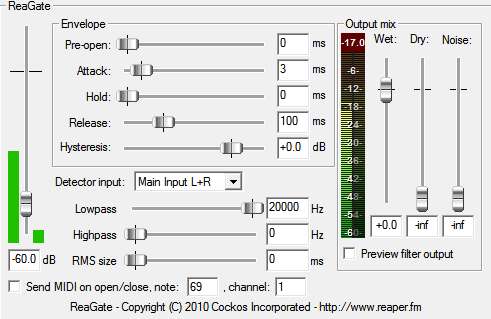
I use this plugin to remove the background hiss of the electric guitar when its volume drops below a certain threshold. The threshold here is -60 dB. If the volume of the lead guitar 1 audio track falls below this threshold, the sound is cut. This plugin is useful because the settings used by the amp simulator chosen for this guitar generate a significant amount of hiss that becomes too audible when no notes are being played. Here are the settings used with the Rea Gate plugin by Cockos:

Rea Gate Plugin
Rea Gate Plugin

Amp Head Simulator

Here is the sound of lead guitar 1 going through an amp head simulator


(mp3 file)

As with real hardware, this sound isn't enough on its own; we'll need to run the signal through a cabinet.

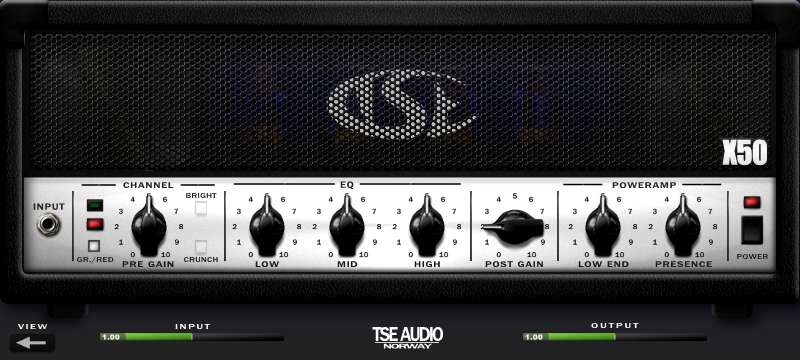
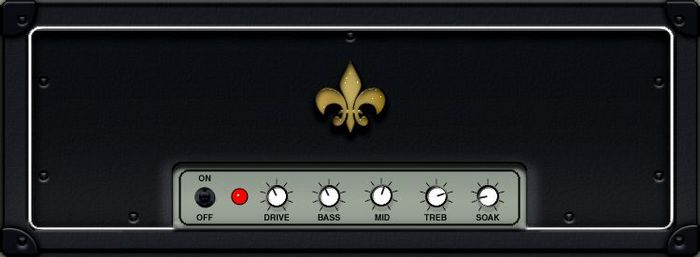
For Lead Guitar 1, I chose the X50 plugin from TSE Audio, one of the best free tube amp simulators. It is available for download here.

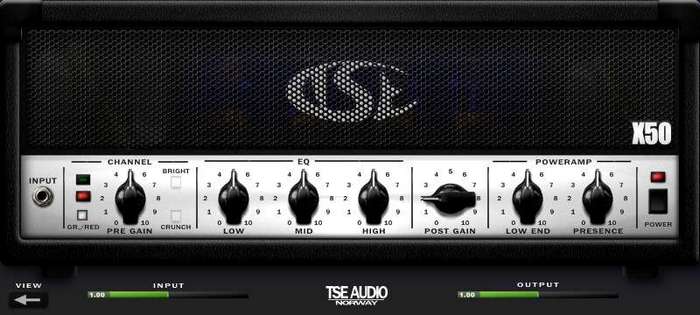
Here are the settings used with the TSE Audio X50 plugin (see screenshot below). To complete the sound of this amp simulator, a cabinet simulator still needs to be added.
X50 Plugin
X50 Plugin
X50 Plugin
X50 Plugin

Cabinet Simulator

Here is the sound of lead guitar 1 passing through saturation, an amp head simulator, and a cabinet


(mp3 file)

This sound could stand on its own, but it's very dry. We still need to add a bit of reverb.

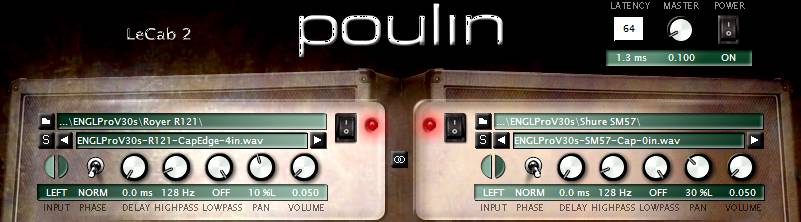
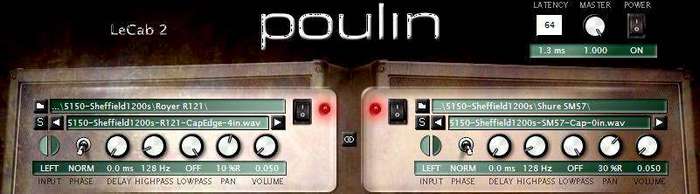
As with real hardware, we now need to connect the amp head (simulated by the X50 plugin) to a cabinet. We'll use the free LeCab 2 plugin by Poulin, into which we'll load impulses. Impulses are "sonic fingerprints" of real cabinets. LeCab 2 allows you to load up to 6 impulses simultaneously. I only used 2 impulses for lead guitar 1, so the screenshot below only shows 2 of the 6 available slots. If you want to download free impulses, you can find some on this page of my site, a bit unorganized... feel free to browse for the ones you need or find others on the web.

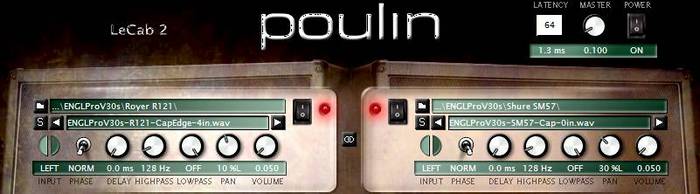
Here are the settings used with the Poulin LeCab 2 plugin:

- I used RedWirez impulses, a high-quality paid collection. Specifically, I used impulses from an EnglPro cabinet equipped with Celestion V30 speakers (the real model costs around €1,000 and weighs over 50 kg!).

- First impulse:

- I chose an impulse taken at the speaker's cap edge with a Royer R-121 mic placed 4" from the grill.

- "Phase": Norm (normal). You can choose normal or inverted phase. This helps eliminate phase issues between different impulses, or when combined with "delay," can produce special effects based on the interaction between impulses.

- "Delay": 0 ms. This knob delays the playback of the sound using this impulse (between 0 and 4.6 ms). I don't need it here, so I left it at 0 ms.

- "HighPass": 128 Hz. I set this parameter to attenuate all frequencies below 128 Hz.

- "LowPass": Off. This knob attenuates high frequencies above the chosen frequency. I'm not concerned with it here, so I didn't enable it.

- "Pan": 10% left

- "Volume": set to 0.050, a very low value because the X50 head with these settings sends a very high volume to the cabinet. To avoid unwanted digital clipping, I had to set this volume very low. The plugin's Master volume is also set very low, at 0.1.

- Second impulse:

- I chose an impulse taken at the speaker's cap edge with a Shure SM57 mic placed as close as possible to the grill.

- "Phase": Norm

- "Delay": 0 ms

- "HighPass": 123 Hz

- "LowPass": Off

- "Pan": 30% left

- "Volume": 0.050

- The blend of these two impulses makes up the sound of rhythm guitar 1.
LeCab 2 Plugin
LeCab 2 Plugin
LeCab 2 Plugin
LeCab 2 Plugin

Equalization

Here is the sound of lead guitar 1 processed with an amp, a cabinet, and reverb (in that order) before equalization...


(mp3 file)


And after equalization:


(mp3 file)

The sound of lead guitar 1 will then be sent to the Lead Guitar bus, where it will join the sound of lead guitar 2.

Now we need to sculpt the sound of lead guitar 1 so it fits as well as possible in the mix. I used the TrackPlug plugin from Wave Arts, an excellent paid parametric EQ. As an alternative, you can use Cockos ReaEQ, a free parametric equalizer that allows you to EQ the sound in much the same way as TrackPlug, though it is slightly less feature-rich for certain tasks.

Here are the settings used with the Wave Arts TrackPlug plugin:

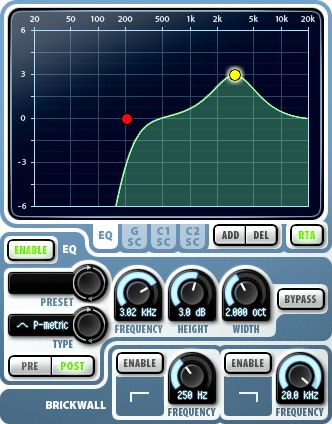
- I placed a HighPass band at 200 Hz (red dot) to start rolling off low frequencies from that point.

- However, I boosted 3.02 KHz by 3 dB with a 2-octave width (yellow dot) to better bring out the guitar's mid-range.

- No compression is applied to this guitar for now. A slight boost will be added using a limiter on the Lead Guitar bus.
TrackPlug Plugin
TrackPlug Plugin
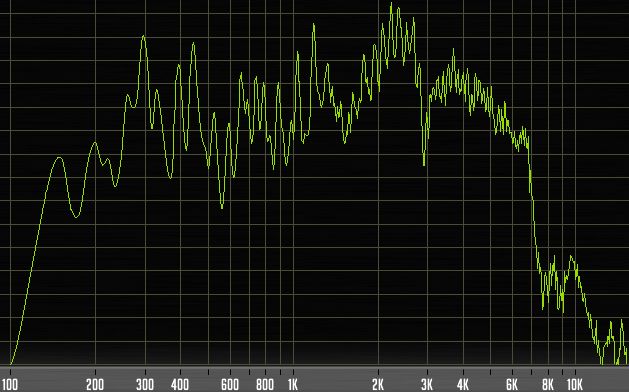
Lead guitar 1 frequencies
Mixing in practice : Preparing the session | Bass | Drums | Rhythm guitars | Lead guitars | Synths | Vocals | Mastering
Haut de page

LEAD GUITAR 2

Raw Sound - Amp Head Simulator - Cabinet Simulator - Equalization

Mono audio track
Panning: 90% right
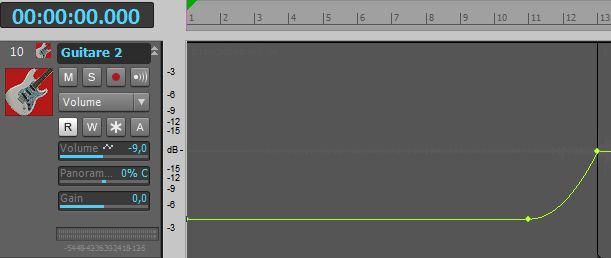
Volume: Variable, as I applied volume automation. From bar 1 to bar 11, the track volume is at -9 dB. From bar 11 to bar 13, I applied a slow exponential curve that rises to 0 dB. The track volume then remains constant at 0 dB. The goal here is to produce a volume swell (fade-in) to create tension and an "announcement" effect. Heads up—the intro is ending, something new is about to happen!
Life - Lead guitar 2 volume automation
Lead guitar 2 volume automation

The plugins used are chained in this order: amp head simulator, cabinet simulator, parametric equalizer.

Lead Guitar 2 Raw Sound

Here is the sound of lead guitar 2 before applying any processing


(mp3 file)

Amp Head Simulator

Here is the sound of lead guitar 2 passing through an amp head simulator


(mp3 file)

As with real hardware, this sound isn't enough on its own; the signal needs to pass through a cabinet.

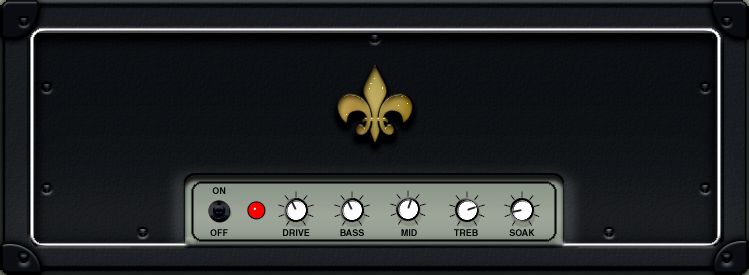
I'm adding an amp head simulator. I chose the Harmony plugin by Simple VST, as its tone complements lead guitar 1 very well. It is available for download here.

Here are the settings used with the Simple VST Harmony plugin (see screenshot below). To complete the sound of this amp simulator, we still need to add a cabinet simulator:
Harmony Plugin
Harmony Plugin
Harmony Plugin
Harmony Plugin

Cabinet Simulator

Here is the sound of lead guitar 2 passing through an amp head simulator and a cabinet


(mp3 file)

This sound could stand on its own, but it's very dry. We still need to add a bit of reverb.

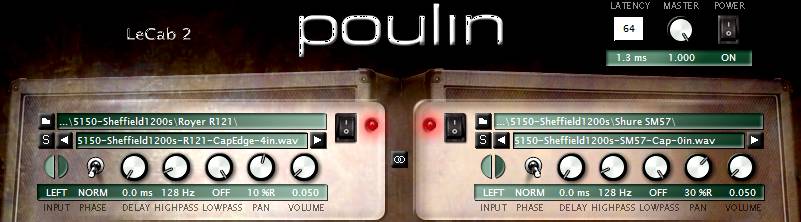
Just like with real gear, the amp head (simulated by the Harmony plugin) must now be connected to a cabinet. We will use the free LeCab 2 plugin by Poulin, into which we will load impulses. Impulses are "sonic fingerprints" of real cabinets. LeCab 2 allows you to load up to 6 impulses simultaneously. I only used 2 impulses for this part, so the screenshot below shows only 2 of the 6 available slots. If you wish to download free impulses, you can find some on this page of my site, though they are a bit unorganized... feel free to search for the impulses you need or find others on the web.

Here are the settings used with the Poulin LeCab 2 plugin:

- I used RedWirez impulses, a high-quality paid collection. For lead guitar 2, I used impulses from a Peavey 5150 cabinet equipped with Celestion Sheffield speakers (the real model is no longer in production but weighs nearly 45 kg!).

- First impulse:

- I chose an impulse taken at the speaker's cap edge with a Royer R-121 mic placed 4" (about 10 cm) from the grill.

- "Phase": Norm (normal). You can choose normal or inverted phase. This can be used to fix phase issues between different impulses or, combined with "delay," to produce special effects that play on the interaction between different impulses.

- "Delay": 0 ms. This knob is used to delay the playback of the sound using this impulse (between 0 and 4.6 ms). I don't need it here, so I left it at 0 ms.

- "HighPass": 128 Hz. I set this parameter to attenuate all frequencies below 128 Hz.

- "LowPass": Off. This knob attenuates high frequencies beyond the chosen frequency. I'm not using it here, so it remains inactive.

- "Pan": 10% right

- "Volume": Set to 0.050, a very low volume, but the plugin's Master volume is set to 1. Given the volume coming from the amp head, this is sufficient here.

- Second impulse:

- I chose an impulse taken at the center of the speaker's dome (cap) with a Shure SM57 mic placed against the grill.

- "Phase": Norm

- "Delay": 0 ms

- "HighPass": 128 Hz

- "LowPass": Off

- "Pan": 30% right

- "Volume": 0.050

- The blend of these two impulses makes up the sound of lead guitar 2.
LeCab 2 Plugin
LeCab 2 Plugin
LeCab 2 Plugin
LeCab 2 Plugin

Equalization

Here is the sound of lead guitar 2 processed with an amp, a cabinet, and reverb (in that order) before equalization...


(mp3 file)


And after equalization


(mp3 file)

The sound of lead guitar 2 will then be sent to the Lead Guitar bus, where it will join lead guitar 1.

Now we need to sculpt the sound of lead guitar 2 so it sits perfectly in the mix. On this track, I used the TrackPlug plugin from Wave Arts, an excellent paid EQ plugin. As an alternative, you can download Cockos ReaEQ, a free parametric equalizer that works much like TrackPlug, though it’s slightly less comprehensive for certain adjustments.

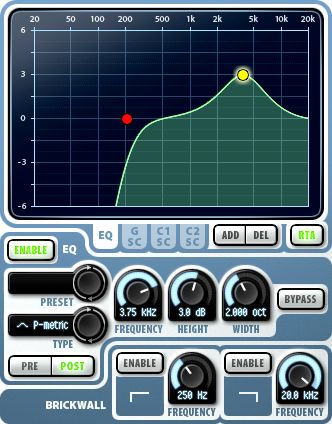
Here are the settings used with the Wave Arts TrackPlug plugin:

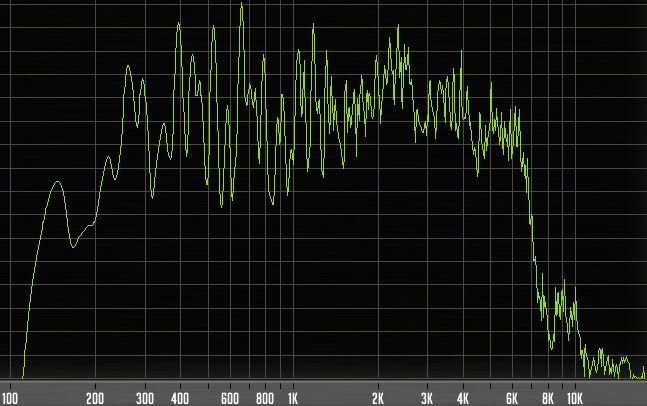
- I placed a HighPass band at 200 Hz (red dot) to start rolling off the low frequencies. You can see further down in the frequency analyzer screenshot that the volume drops rapidly below this frequency, dying out completely around 120 Hz.

- I boosted 3.75 KHz by 3 dB (yellow dot) to help the guitar's mid-range stand out.

- No compression is applied to this guitar for now. A slight boost will be added using a limiter on the Lead Guitar bus.
TrackPlug Plugin
TrackPlug Plugin
Lead guitar 2 frequencies
Mixing in practice : Preparing the session | Bass | Drums | Rhythm guitars | Lead guitars | Synths | Vocals | Mastering
Haut de page

LEAD GUITARS BUS

Here is the sound of the two lead guitars without the limiter...


(mp3 file)


And with the limiter


(mp3 file)

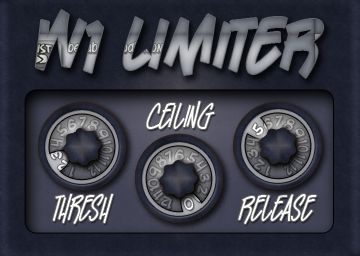
This stereo bus is where the sounds from both lead guitar tracks are summed. Here, I'm using the FinalPlug plugin by Wave Arts, a paid brickwall limiter that boosts the signal to make the guitars more prominent in the track. A brickwall limiter is a type of compressor that prevents the signal from exceeding a set level. If poorly adjusted (with too much compression), it can squash the sound and even cause distortion. When set correctly, it simply adds more "punch" to the audio. As an alternative, you can use George Yohng's W1 Limiter (shown here with the BetaBugsAudio interface), an excellent free limiter available for download here.

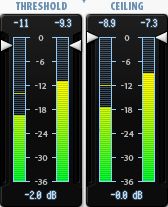
Here are the settings used with the Wave Arts FinalPlug plugin:

- "Threshold": -2 dB. The threshold is the level at which compression triggers to boost the signal. The -2 dB value chosen here is quite subtle, only boosting the signal by a maximum of 2 dB. The free Classic Master Limiter offers only this single adjustment, allowing you to set the threshold between -20 and 0 dB.

- "Ceiling": 0 dB. The ceiling is the maximum level the sound cannot exceed. In this case, any sound reaching within 2 dB of the maximum allowed bus volume is boosted by 2 dB but won't cross the ceiling. A 0 dB ceiling actually corresponds to the volume of the bus (or track) where the plugin is placed. Since the bus volume is -10 dB here, the actual threshold is -12 dB, and the actual ceiling is -10 dB.

Reverb

Here is the sound of the Lead Guitar bus processed with reverb.
You can only hear the effect of the reverb itself here.


(mp3 file)

I then set this reverb to 25% to achieve the desired effect.

Now that our lead guitars have passed through distortion, an amp head, and a cabinet, we'll add some "air" with a reverb plugin so the sound doesn't feel too cramped. I used WizooVerb, a plugin that hasn't been for sale for several years but still sounds great. It can still be found in the darker corners of the internet (I don't condone it, but you do as you wish), or you can use other paid or free reverb plugins. They are easy to find, and I suggest a few on this page. I commonly use SIR Convolution, which works with impulses, much like cabinet simulators. But instead of using cabinet impulses, we use room impulses recorded in various locations (from bathrooms to cathedrals, concert halls, or standard house rooms).

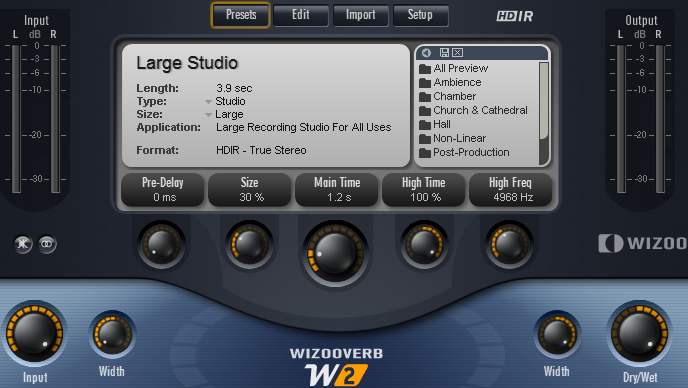
Here are the settings used with the WizooVerb plugin by Wizoo:

- I used the "Large Studio" preset (a versatile large recording studio). I reduced its "size" to 30% to avoid making it sound like a massive hall; the decay time is set to 1.2s and I adjusted the "Width" parameters so the reverb spreads across the stereo field. However, since the bus panning is set to 90% left, the reverb only propagates on the left side.

- The reverb amount is controlled with the "Dry/Wet" knob. At 0%, you hear no reverb at all; at 100%, you only hear the reverb without the dry signal. For lead guitar 1, it is set to 25%.

- Using reverb on a guitar is common practice. The dosage is a matter of personal preference, but too much reverb distances the instrument and can drown it in the mix.
WizooVerb Plugin
WizooVerb Plugin
- The lead guitar sound is now finalized for the mix. It will only be modified further during the final mastering stage.
FinalPlug Plugin
FinalPlug Plugin
W1 Limiter Plugin
W1 Limiter Plugin
Mixing in practice : Preparing the session | Bass | Drums | Rhythm guitars | Lead guitars | Synths | Vocals | Mastering
Haut de page
Top of page


MESSAGES

(leave a message)

Messages page # 1 2 3 4 5 6 7 8 9 10 11 12 13 14 15 16 17 18 19 20 21 22 23 24 25 26 27 28 29 30 31 32 33 34 35


lgwn
le 08/05/2012 à 18h42

Merci pour tout, super boulot.


Malandain
le 24/04/2012 à 14h37

Bonjour,

J'ai un dr4d akai qui enregistre en 16 bits (44/48khz).
Je relie numériquement mon dr4d à ma carte son (spdif) qui est reliée a mon ordi en usb. Ma D.A.W. est Mixbus qui enregistre en 32/24/16 bits.
Pour un bon enregistrement, faut-il mieux mettre tout en 16 bits ? (dr4d + carte son + D.A.W.)
Peut-on enregistrer le 16 bits du dr4d en 24 bits carte son + D.A.W. ?
Ou 16 bits du dr4d vers 16 bits carte son et 24 bits Mixbus ?
J'ai l'impression que tout en 16 bits, c'est mieux.

Merci d'éclairer ma lanterne.

A. Malandain

* * * * * * * * * * * * * * * *

<em>Bonjour,

Bienvenue sur mon site !

Puisque le dr4d enregistre en 16 bits, il semble logique de penser que tu ne gagneras a priori pas en qualité en réglant carte son et séquenceur sur 24 bits.

C'est vrai si tu te contentes de "transférer" les sons enregistrés avec le dr4d vers ton séquenceur sans les traiter ensuite.

En revanche, si tu fais du mix depuis Mixbus, en utilisant des effets, là il vaut mieux être en 24 bits, car les calculs effectués par le logiciel seront plus précis.

Il est très probable que la différence sera imperceptible, et travailler en 16 bits de bout en bout ne va pas dégrader le son obtenu.

Je ne pense pas que beaucoup de gens soient capables d'entendre la différence entre un traitement effectué en 16 bits et le même traitement effectué en 24 bits.

Néanmoins, la différence existe au niveau de la précision des calculs, et l'accumulation des effets sur différentes piste peut entraîner en 16 bits un risque (très faible) d'avoir quelques petites approximations qui vont se traduire par une légère dégradation du son. Encore une fois, c'est théorique, ça peut arriver, mais ça ne sera pas forcément quelque chose qui va s'entendre.

Donc si tu es pointilleux, je te conseille de régler ta carte son et ta D.A.W. sur 24 bits.

Grebz</em>


Franck
le 02/04/2012 à 03h34

Bonjour Grebz,

J'ai vu que tu utilisais Sonar X1 Producer.
J'aimerais bien si tu veux que tu me donnes quelques truc pour ce logiciel car sur Internet, il n'y a que des vidéos anglo et je ne les comprend pas toutes.

Merci d'avance.

* * * * * * * * * * * * * * * *

<em>Bonjour,

Pour ceux que ça intéresse, j'ai fait ce petit guide rapide pour savoir comment intégrer et utiliser un VSTi (synthé virtuel) dans Sonar X1. Ce ne sont que les bases, mais ça pourra servir à ceux qui sont perdus.

Télécharger "<a href="/Downloads/tutorial_homestudio/Synthés virtuels dans Sonar X1.pdf">Synthés virtuels dans Sonar X1</a>" (Fichier PDF de 1,20 Mo)

Grebz</em>


Molten
le 13/03/2012 à 01h27

Merci mon ami : Excellent !!!


Alain6465
le 08/03/2012 à 00h54

Merci pour ton site qui est très utile pour un novice comme moi dans la MAO, même si je fais de la musique depuis longtemps.

J'ai l'intention de revendre mon matériel hardware et d'acheter un séquenceur en soft. Je penche pour Sonar car j'aime bien l'interface graphique de studio instrument, mais je ne sais quelle version choisir, Sonar Studio ou Producer ou X1 etc.

De plus, je n'ai pas vu la VS-100 de Cakewalk dans tes choix de carte son, qu'en penses-tu ? Serait-ce un bon choix, car elle a été conçue pour être utilisée avec Sonar je crois.

Merci pour ta réponse et pour tes conseils très pédagogiques !

* * * * * * * * * * * * * * * *

<em>Bonjour,

Merci de ta visite sur mon site.

Pour l'interface V-Studio 100, je ne l'ai pas listée car je ne l'ai jamais utilisée et j'ai simplement référencé quelques marques connues, mais ce n'est pas du tout un choix exhaustif. Je suis un simple passionné de musique, pas un professionnel du test, et je ne me permets de parler en détail que du matériel et des logiciels que je connais !

J'ai été voir divers avis d'utilisateurs de la VS-100 et ils sont globalement très positifs, tant en ce qui concerne la qualité des pré-amplis que de l'aspect pratique des différents boutons présents sur l'interface, qui donnent un accès direct à de nombreuses fonctions du séquenceur utilisé. Effectivement, la carte a été conçue par Roland, qui est aussi l'éditeur de Sonar, et donc Sonar reconnaît immédiatement la VS-100 et attribue directement les bonnes fonctions aux bonnes touches de l'interface. Mais la VS-100 fonctionne aussi très bien avec les autres séquenceurs, avec lesquels il est tout à fait possible de configurer les boutons pour leur attribuer les fonctions voulues. Conclusion : même si je ne l'ai jamais utilisée moi-même, cette interface me semble être un bon choix.

Pour le choix d'un séquenceur maintenant... En tant qu'utilisateur de Sonar depuis plusieurs années, je vais évidemment te dire que c'est un très bon choix. L'interface me convient, je le trouve assez intuitif à utiliser et largement assez riche et puissant pour moi. Point important : Sonar est livré avec beaucoup de plugins (VST, VSTi) et outils qui permettent de travailler sans avoir impérativement besoin d'acheter des outils complémentaires. Mais restons objectif, les Cubase et autres Reaper ou Presonus Studio One sont aussi d'excellents logiciels. Je crois que c'est surtout une question de feeling, de coup de cœur... et de prix ! Tous les séquenceurs sérieux permettent de parvenir plus ou moins aux mêmes résultats, chacun avec sa méthode et son organisation.

Dans la gamme Sonar, le dernier en date est Sonar X1, qui existe en 3 versions : Essential, Studio et Producer.
La différence se trouve dans le nombre d'outils livrés avec le logiciel.

<strong>Essential</strong> est la version la moins complète et la moins chère. Elle est disponible uniquement en version 32 bits et est limitée à 64 pistes audio (ce qui suffit à la plupart des gens, moi y compris). Elle ne propose que les fonctions de base (pas de synthés, batterie logicielle, outils de compression évolués, etc.). Environ 90 euros.

<strong>Studio</strong> est disponible en versions 32 ou 64 bits, n'a pas de limitation du nombre de pistes, et possède des outils complémentaires (divers VST, VSTi, V-Vocal pour corriger les problèmes de justesse des voix ou instruments, Audio Snap pour caler des enregistrements sur le tempo). Environ 180 euros.

Enfin, <strong>Producer</strong> est la version la plus complète et la plus chère bien sûr. Elle contient en plus différents outils d'excellente qualité comme le ProChannel (compresseur, EQ, saturation), Session Drummer 3, un logiciel de batterie plutôt bien foutu, les VSTi Dimension Pro (très bon synthé, très complet) et TruePianos (version allégée d'un piano virtuel de très bonne qualité à mon goût). Environ 390 euros.

À sa sortie fin 2010, X1 n'était pas super stable et plantait un peu trop souvent à mon goût. Du coup, en attendant les correctifs, je continuais à utiliser la version précédente, mais c'est très frustrant et décevant de payer pour un logiciel qui ne marche pas aussi bien que ce que vous attendez. Mais heureusement, les correctifs ont rapidement amélioré la situation et la version de X1 actuellement en vente est nickel.

J'ai encore quelques plantages de temps à autres, mais j'ai pu constater que c'était toujours à cause de certains VST que j'ai ajoutés. La faute donc aux programmeurs de ces VST qui perturbent Sonar dans certaines conditions (pas toujours très claires à déterminer, d'ailleurs). Ça n'arrive d'ailleurs qu'avec des VST gratuits. Je n'ai jamais eu de plantages à cause de VST du commerce. Normal, puisque les conditions de tests ne sont pas les mêmes... Entre un bidouilleur passionné qui développe son VST dans son coin et une société qui peut tester sur tous les séquenceurs du marché, il y a une différence. N'empêche que beaucoup de VST gratuits sont non seulement utiles, mais aussi performants que certains logiciels du commerce.

Grebz</em>

Top of page