Life features two rhythm guitars playing different parts. The first guitar is panned to the left and the other to the right. Both guitars were recorded using a Fender Stratocaster plugged directly into an M-Audio AudioBuddy preamp, which was connected to an Edirol FA-101 audio interface. I didn't use a real guitar amp with microphones. Everything was done using amp and cabinet simulation plugins along with various effects plugins.
Here is the complete list of plugins used for the first rhythm guitar:
* Tube Saturator by Wave Arts, a vacuum tube saturation simulation
* Urrth by Simple VST, a free guitar amp simulator
* LeCab 2 by Poulin, a free impulse response (IR) loader for my cabinet impulses
* Orange PPC412 cabinet impulses from the RedWirez BigBox paid collection ($9 USD per cab, with volume discounts)
* WizooVerb by Wizoo, a software reverb
* TrackPlug by Wave Arts, a parametric equalizer
Here is the complete list of plugins used for the second rhythm guitar:
* Tube Saturator by Wave Arts, a vacuum tube saturation simulation
* Hybrit by Poulin, a free guitar amp simulator
* LeCab 2 by Poulin, a free impulse response (IR) loader for my cabinet impulses
* Vox AC30 Blues cabinet impulses from the RedWirez BigBox paid collection ($9 USD per cab, with volume discounts)
* WizooVerb by Wizoo, a software reverb
* TrackPlug by Wave Arts, a parametric equalizer
And finally, one last plugin applied to the bus where the sound of both guitars—previously processed separately—comes together:
* FinalPlug by Wave Arts, a limiter
For any paid plugins, I will suggest free alternatives you can use instead.
Mono audio track
Panning: 90% left. Therefore, the sound of rhythm guitar 1 will be heard almost exclusively on the left side.
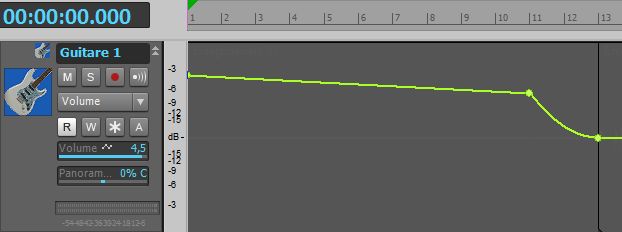
Volume: variable because I applied volume automation. From measure 1 to measure 11, the track volume goes from +4.5 dB to +3.5 dB following a linear curve. From measure 11 to measure 13, I applied a fast exponential curve descending to 0 dB. The track volume then remains constant at 0 dB. I did this because the recording level of the guitar at the beginning of the song was very low. Rather than re-recording this part, I preferred to use automation to adapt the volume to the mix's needs.
Rhythm guitar 1 volume automation
The plugins used are chained in this order: tube saturation, amp head simulator, cabinet simulator, reverb, parametric equalizer.
Rhythm Guitar 1 Raw Sound
Here is the sound of rhythm guitar 1 before applying any processing
Obviously, as it is, the sound isn't very pleasant! It's just the direct sound of the electric guitar, so we're going to run it through various plugins to turn it into something more interesting.
Tube Saturation
Here is the sound of rhythm guitar 1 processed with tube saturation
At this stage, it's simply a direct-recorded guitar with added saturation. It still needs to go through an amp!
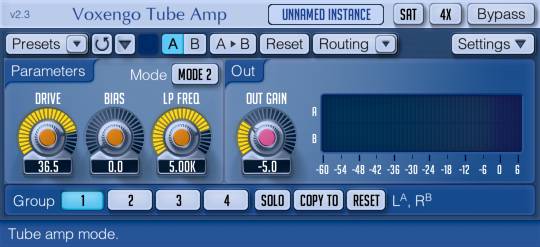
Here I'm using a plugin to add saturation to the sound, specifically tube saturation. It's not a distortion or overdrive pedal, but it warms up the sound nicely. I used Wave Arts' Tube Saturator. Since this is a paid plugin, you can replace it with Tube Amp, a free equivalent from Voxengo that provides the same type of tube saturation. Even if the settings differ, you can achieve a similar tone.
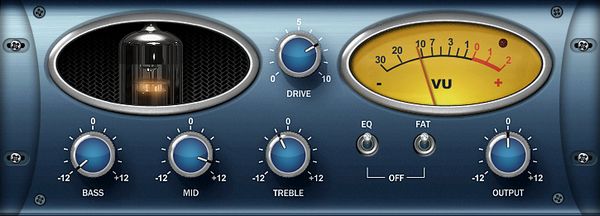
Here are the settings used with the Wave Arts Tube Saturator plugin:
- "EQ" is enabled (otherwise, "Bass," "Mid," and "Treble" functions are inactive)
- "Bass" is set to the minimum to attenuate low frequencies as much as possible
- "Mid" is set to 4 o'clock to help the guitar sound stand out
- "Treble" is at 11 o'clock to slightly decrease the high-end level
- "Drive" is set to 2 o'clock for a relatively warm saturation
- "Fat" is enabled. This allows for a higher level of saturation when turned on.
- "Output" is set to 12 o'clock. This is the output level, adjusted so the peak signal doesn't exceed 0 dB.
Tube Saturator Plugin
A free equivalent: Voxengo's Tube Amp plugin. The settings shown here provide nearly the same sound as Tube Saturator.
Amp Head Simulator
Here is the sound of rhythm guitar 1 going through saturation and an amp head simulator
As with real hardware, this sound isn't enough on its own; we'll need to run the signal through a cabinet.
After the saturation plugin, I add an amp head simulator. To keep a light tone, I chose the Urrth plugin by Simple VST, a free amp simulator that produces nice clean sounds. It can be downloaded here.
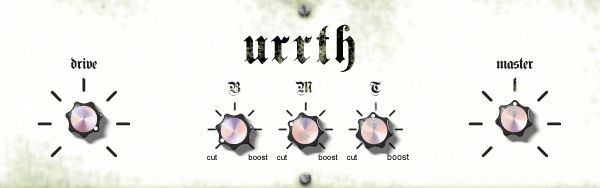
Here are the settings used with the Simple VST Urrth plugin:
- "Drive" is cranked to the maximum. This is a gain knob: the more you increase it, the more both volume and distortion increase. However, even at max, the distortion remains quite light, adding to the saturation from the Tube Saturator plugin placed just before it.
- "B" (bass) is set to the minimum. I'm looking to remove as much low-end as possible from this guitar to leave those frequencies for instruments that need them more in this mix. The goal here is to have light rhythm guitars in a higher register.
- "M" (mid) is at 10 o'clock to slightly lower the mids produced by this amp. The sound tends to become muffled quickly when I try to increase the mid-level with this plugin.
- "T" (treble) remains centered. More is too much, less is not enough!
- "Master" is the amp's master volume. I leave it centered and adjust the volume directly on the bus. Since this amp simulator has a rather high output level, even with the volume centered, I have to set the bus volume to -33 dB to avoid clipping!
- To complete the sound of this amp simulator, we still need to add a cabinet simulator.
Urrth Plugin
Cabinet Simulator
Here is the sound of rhythm guitar 1 going through saturation, an amp head simulator, and a cabinet
This sound could stand on its own, but it's very dry. We still need to add a bit of reverb.
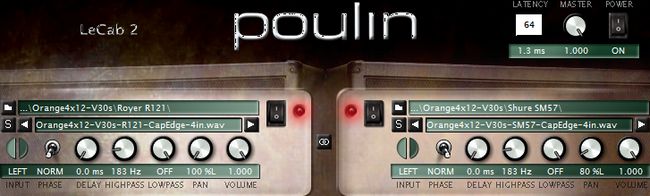
As with real hardware, we now need to connect the amp head (simulated by the Urrth plugin) to a cabinet. We'll use the free LeCab 2 plugin by Poulin, into which we'll load impulses. Impulses are "sonic fingerprints" of real cabinets. LeCab 2 allows you to load up to 6 impulses simultaneously. I only used 2 impulses for rhythm guitar 1, so the screenshot below only shows 2 of the 6 available slots. If you want to download free impulses, you can find some on this page of my site, though they are a bit unorganized... feel free to browse for what interests you or find others on the web.
Here are the settings used with the Poulin LeCab 2 plugin:
- I used RedWirez impulses, a high-quality paid collection. Specifically, I used impulses from an Orange PPC412 cabinet equipped with Celestion V30 speakers (the real model costs around €800 and weighs nearly 50 kg!).
- First impulse:
- I chose an impulse taken at the speaker's cap edge with a Royer R-121 mic placed 4" from the grill.
- "Phase": Norm (normal). You can choose normal or inverted phase. This helps eliminate phase issues between different impulses, or when combined with "delay," can produce special effects based on the interaction between impulses.
- "Delay": 0 ms. This knob delays the playback of the sound using this impulse (between 0 and 4.6 ms). I don't need it here, so I left it at 0 ms.
- "HighPass": 183 Hz. I set this parameter to attenuate all frequencies below 183 Hz.
- "LowPass": Off. This knob attenuates high frequencies above the chosen frequency. I'm not concerned with it here, so I didn't enable it.
- "Pan": 100% left
- "Volume": set to 1, the maximum value.
- Second impulse:
- I chose an impulse taken at the cap edge with a Shure SM57 mic placed 4" from the grill.
- "Phase": Norm
- "Delay": 0 ms
- "HighPass": 183 Hz
- "LowPass": Off
- "Pan": 80% left
- "Volume": 1
- The blend of these two impulses makes up the sound of rhythm guitar 1.
LeCab 2 Plugin
Reverb
Here is the sound of rhythm guitar 1 processed with reverb. You can only hear the effect of the reverb itself here.
I then set this reverb to 25% to achieve the effect I'm looking for.
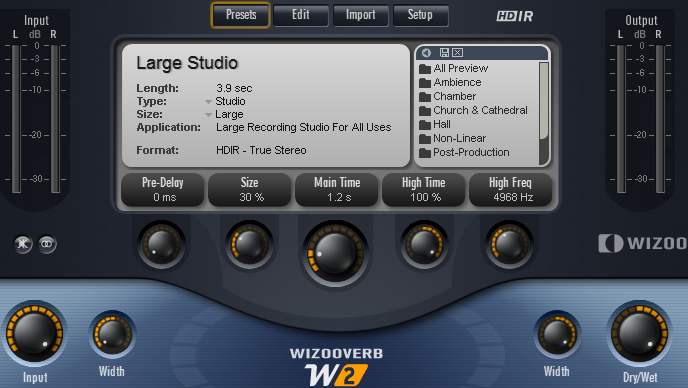
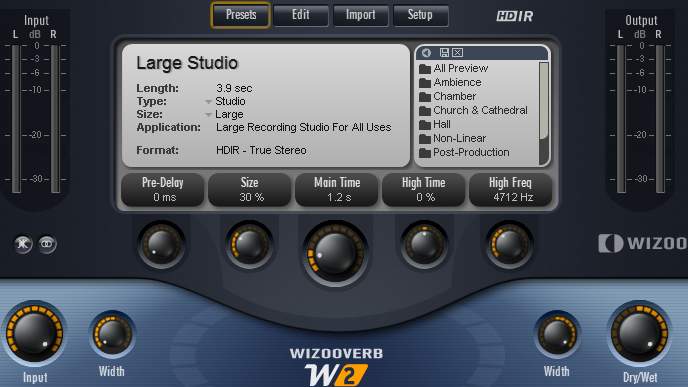
Now that our rhythm guitar 1 has passed through saturation, an amp head, and a cabinet, we'll add some "air" with a reverb plugin so the sound doesn't feel too confined. I used the WizooVerb plugin, which hasn't been sold for a few years but still sounds great. You can still find it in the darker corners of the internet (I don't condone it, but do as you wish), or you can use other paid or free reverb plugins. They are easy to find, and I suggest a few on this page. I commonly use SIR Convolution, which works with impulses just like cabinet simulators. But instead of cabinet impulses, you use room impulses recorded in various locations (from bathrooms to cathedrals, concert halls, or rooms in a house).
Here are the settings used with the Wizoo WizooVerb plugin:
- I used the Large Studio preset (a large multi-purpose recording studio). I reduced its "size" to 30% to avoid making it sound like it was recorded in an enormous room. The reverb time is set to 1.2s, and I adjusted the "Width" parameters so the reverb spreads in stereo. However, since the bus panning is set to 90% left, the reverb only spreads on the left side.
- The reverb amount is controlled with the "DryWet" knob. At 0%, you hear no reverb at all; at 100%, you only hear the reverb and no dry sound. For rhythm guitar 1, it's set to 25%.
- Using reverb on a guitar is common. The dosage is a matter of personal preference, but too much reverb pushes the instrument away and drowns it in the mix.
WizooVerb Plugin
Equalization
Here is the sound of rhythm guitar 1 processed with saturation, amp, cabinet, and reverb (in that order) before equalization...
The sound of rhythm guitar 1 will then be sent to the Rhythm Guitar bus, where it will join rhythm guitar 2.
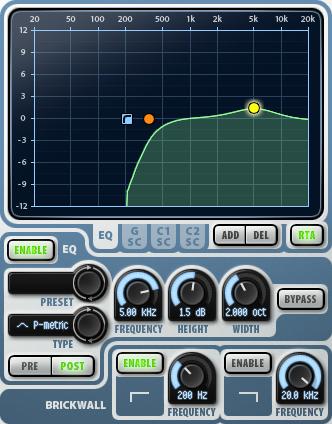
Now that the sound of rhythm guitar 1 is complete, it still needs to be sculpted to fit perfectly into the mix. I used Wave Arts' TrackPlug, an excellent paid parametric EQ plugin. As a replacement, you can use Cockos ReaEQ, a free parametric equalizer that allows you to equalize the sound in almost the same way, though it is slightly less feature-rich for certain tasks.
Here are the settings used with the Wave Arts TrackPlug plugin:
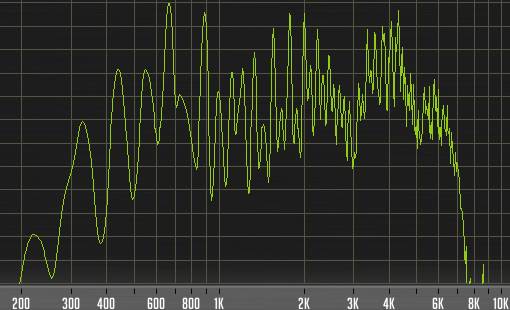
- I used a brickwall filter at 200 Hz to completely cut all low frequencies below this value. This simply reinforces what was done previously: bass at minimum on the Tube Saturator and Urrth amp, and the HighPass set to 183 Hz on LeCab 2. A quick look at a frequency analyzer (see screenshot below) confirms that nothing passes below 200 Hz. It's radical, but intentional.
- I placed a HighPass band at 350 Hz (orange dot) to begin rolling off low frequencies starting at this value. You can see in the screenshot that the volume decreases to about -10 dB before the brickwall sharply cuts the sound at 200 Hz.
- On the other hand, I very slightly boosted 5 KHz by 1.5 dB with a 2-octave width to bring out the guitar's brightness. There's no need to boost more here, as it would have made the sound too harsh and aggressive.
- No compression is applied to this guitar for now. A slight boost will be added using a limiter on the Rhythm Guitar bus.
Mono audio track
Panning: 90% right
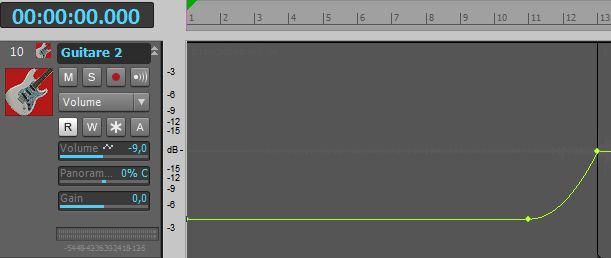
Volume: variable because I applied volume automation. From measure 1 to measure 11, the track volume is at -9 dB. From measure 11 to measure 13, I applied a slow exponential curve rising to 0 dB. The track volume then remains constant at 0 dB. The goal here is to produce a volume swell to create tension and act as a lead-in. Heads up: the intro is ending, and something new is about to happen!
Rhythm guitar 2 volume automation
The plugins used are chained in this order: amp head simulator, cabinet simulator, reverb, parametric equalizer.
Rhythm Guitar 2 Raw Sound
Here is the sound of rhythm guitar 2 before applying any processing
As with Rhythm Guitar 1, here is the direct sound of the electric guitar, which we will run through various plugins to turn it into something more interesting.
Amp Head Simulator
Here is the sound of rhythm guitar 2 going through an amp head simulator
As with real hardware, this sound isn't enough on its own; we'll need to run the signal through a cabinet.
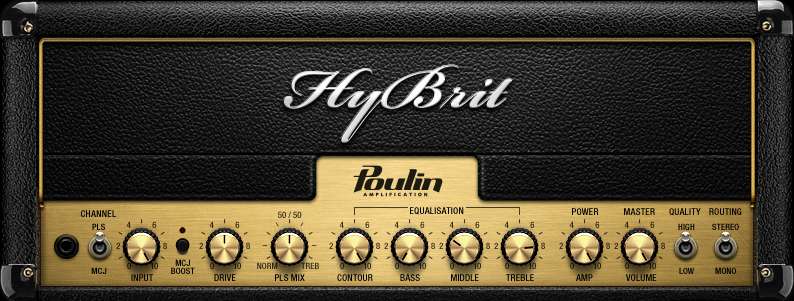
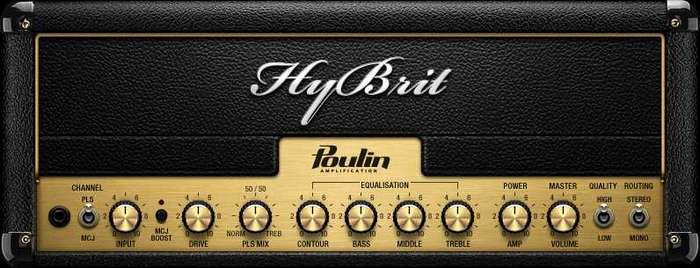
I'm adding an amp head simulator. I chose the Hybrit plugin by Poulin, which produces a very British vintage sound. The tone has more crunch than Rhythm Guitar 1, and their sonic characters complement each other well. It can be downloaded here.
Here are the settings used with the Poulin Hybrit plugin:
- "input" is set to maximum. This is the level of the signal entering the amp head.
- "PLS/MCJ": PLS. This switch allows for two different types of tones. They represent the two channels of the amp, with varying levels of distortion.
- "MCJ boost": intended for the MCJ channel. It is, of course, not enabled here since I chose the PLS channel.
- "Drive": set to 12 o'clock. This is the distortion level.
- "50/50 PLS Mix": set to 12 o'clock. This is a general tone setting, ranging from bass (which I find a bit dull) to treble (too aggressive for my taste if pushed to the max).
- "Cont" (contour): set to maximum. This knob affects the other EQ knobs: "Low", "Mid", and "High". The higher you turn it, the more influence the EQ settings will have. Conversely, the lower it is, the less impact the EQ settings will have.
- "Low" (bass) is set to the minimum. I'm looking to remove as much low-end as possible from this guitar to leave those frequencies for instruments that need them more in this mix. The goal here is to have light rhythm guitars in a higher register.
- "Mid" is at 3, to slightly lower the mids.
- "High" (treble) is at 8, for better clarity.
- "Power Amp": set to maximum. This is the gain level, which adds more or less saturation to the sound.
- "Master Volume": set to maximum. This is the amp's general volume knob.
- To complete the sound of this amp simulator, a cabinet simulator must be added.
Hybrit Plugin
Hybrit Plugin
Cabinet Simulator
Here is the sound of rhythm guitar 2 going through an amp head simulator and a cabinet
This sound could stand on its own, but it's very dry. We still need to add a bit of reverb.
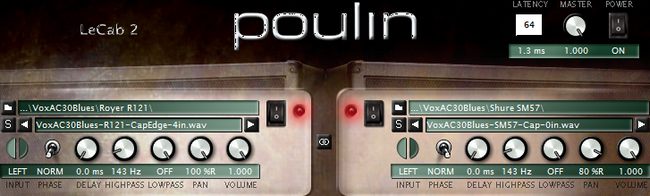
As with real hardware, we now need to connect the amp head (simulated by the Hybrit plugin) to a cabinet. We'll use the free LeCab 2 plugin by Poulin, into which we'll load impulses. Impulses are "sonic fingerprints" of real cabinets. LeCab 2 allows you to load up to 6 impulses simultaneously. I only used 2 impulses for the guitar, so the screenshot below only shows 2 of the 6 available slots. If you want to download free impulses, you can find some on this page of my site, though they are a bit unorganized... feel free to browse for what interests you or find others on the web.
Here are the settings used with the Poulin LeCab 2 plugin:
- I used RedWirez impulses, a high-quality paid collection. For rhythm guitar 2, I used impulses from a Vox AC30 Blues cabinet equipped with Celestion Alnico Blues speakers (the real model costs around €1,200 and weighs over 30 kg!).
- First impulse:
- I chose an impulse taken at the speaker's cap edge with a Royer R-121 mic placed 4" from the grill.
- "Phase": Norm (normal). You can choose normal or inverted phase. This helps eliminate phase issues between different impulses, or when combined with "delay," can produce special effects based on the interaction between impulses.
- "Delay": 0 ms. This knob delays the playback of the sound using this impulse (between 0 and 4.6 ms). I don't need it here, so I left it at 0 ms.
- "HighPass": 143 Hz. I set this parameter to attenuate all frequencies below 143 Hz.
- "LowPass": Off. This knob attenuates high frequencies above the chosen frequency. I'm not concerned with it here, so I didn't enable it.
- "Pan": 100% right
- "Volume": set to 1, the maximum value.
- Second impulse:
- I chose an impulse taken at the speaker's cap with a Shure SM57 mic placed against the grill.
- "Phase": Norm
- "Delay": 0 ms
- "HighPass": 143 Hz
- "LowPass": Off
- "Pan": 80% right
- "Volume": 1
- The blend of these two impulses makes up the sound of rhythm guitar 2.
LeCab 2 Plugin
Reverb
Here is the sound of rhythm guitar 2 processed with reverb. You can only hear the effect of the reverb itself here.
I then set this reverb to 25% to achieve the effect I'm looking for.
Now that our rhythm guitar 2 has passed through an amp head and a cabinet, we'll add some "air" with a reverb plugin so the sound doesn't feel too confined. I used the WizooVerb plugin, which hasn't been sold for a few years but still sounds great. You can still find it in the darker corners of the internet (I don't condone it, but do as you wish), or you can use other paid or free reverb plugins. They are easy to find, and I suggest a few on this page. I commonly use SIR Convolution, which works with impulses just like cabinet simulators. But instead of cabinet impulses, you use room impulses recorded in various locations (from bathrooms to cathedrals, concert halls, or rooms in a house).
Here are the settings used with the Wizoo WizooVerb plugin:
- I used the Large Studio preset (a large multi-purpose recording studio). I reduced its "size" to 30% to avoid making it sound like it was recorded in an enormous room. The reverb time is set to 1.2s, and I adjusted the "Width" parameters so the reverb spreads in stereo. However, since the track panning is set to 90% right, the reverb only spreads on the right side.
- The reverb amount is controlled with the "DryWet" knob. At 0%, you hear no reverb at all; at 100%, you only hear the reverb and no dry sound. For rhythm guitar 2, it's set to 25%.
- Using reverb on a guitar is common. The dosage is a matter of personal preference, but too much reverb pushes the instrument away and drowns it in the mix.
WizooVerb Plugin
Equalization
Here is the sound of rhythm guitar 2 processed with an amp, a cabinet, and reverb (in that order) before equalization...
The sound of rhythm guitar 2 will then be sent to the Rhythm Guitar bus, where it will join rhythm guitar 1.
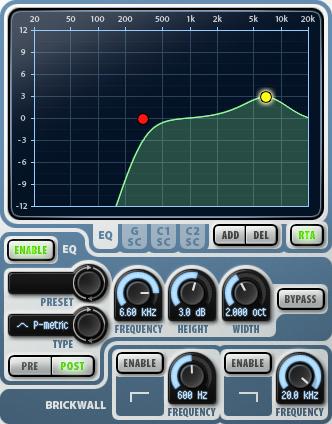
Now that the sound of rhythm guitar 2 is complete, it still needs to be sculpted to fit into the mix. For this track, I used Wave Arts' TrackPlug, an excellent paid EQ plugin. As an alternative, you can download Cockos ReaEQ, a free parametric equalizer that allows you to equalize the sound in nearly the same way, though it is slightly less comprehensive for certain adjustments.
Here are the settings used with the Wave Arts TrackPlug plugin:
- Unlike rhythm guitar 1, no brickwall was used here. Therefore, the low frequencies aren't cut as sharply.
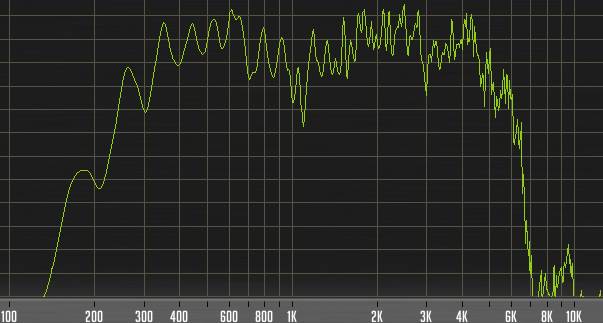
- I placed a HighPass band at 300 Hz (red dot) to begin rolling off low frequencies starting at this value. You can see in the frequency analyzer screenshot below that the volume drops quickly below this frequency and fades out completely around 140 Hz.
- I boosted 6.6 KHz by 3 dB to better bring out the guitar's brightness. A larger increase would have made the sound too harsh and aggressive.
- No compression is applied to this guitar for now. A slight boost will be added using a limiter on the Rhythm Guitar bus.
TrackPlug Plugin
Rhythm guitar 2 frequencies
RHYTHM GUITARS BUS
Here is the sound of the two rhythm guitars without the limiter...
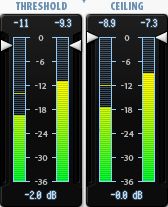
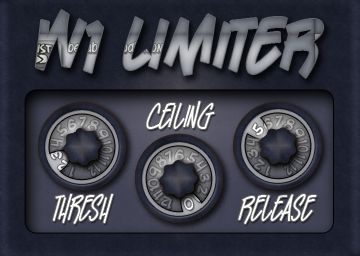
This stereo bus is where the signals from both rhythm guitar tracks meet. Here, I am using Wave Arts' FinalPlug, a paid brickwall limiter plugin used to boost the sound and make the guitars more present in the track. A brickwall limiter is a type of compressor that prevents the signal from exceeding a set level. If poorly adjusted (with too much compression), it can crush the sound and even cause distortion. Properly set, it simply adds more "punch" to the audio it is applied to. As an alternative, you can use George Yohng's W1 Limiter (shown here with the BetaBugsAudio interface), an excellent free limiter available for download here.
Here are the settings used with the Wave Arts FinalPlug plugin:
- "Threshold": -2 dB. The threshold is the level at which the compression is triggered to boost the signal. The -2 dB value chosen here is quite subtle, only boosting the signal by a maximum of 2 dB. The free Classic Master Limiter plugin offers only this single setting, allowing you to adjust the threshold between -20 and 0 dB.
- "Ceiling": 0 dB. The ceiling is the level that the sound cannot exceed. In this case, all sounds reaching within 2 dB of the maximum volume allowed by the bus are increased by 2 dB and cannot surpass this value. The 0 dB ceiling value actually corresponds to the volume of the bus (or track) where the plugin is placed. Here, the bus volume is set to -10 dB, so the actual threshold is -12 dB, and the actual ceiling is -10 dB.
- The rhythm guitar sound is now final for the mix. It will only be modified during the final mastering stage.

 |
|